The post Despite BOJ Concerns, Can SOL Price Hold Its Long-Term Support Zone? appeared first on Coinpedia Fintech News The SOL price is once again under pressureThe post Despite BOJ Concerns, Can SOL Price Hold Its Long-Term Support Zone? appeared first on Coinpedia Fintech News The SOL price is once again under pressure

Despite BOJ Concerns, Can SOL Price Hold Its Long-Term Support Zone?
Solana’s Firedancer Goes Live on Mainnet After 3 Years, Sol jumps by 6%

The post Despite BOJ Concerns, Can SOL Price Hold Its Long-Term Support Zone? appeared first on Coinpedia Fintech News

The SOL price is once again under pressure, but not without context. After slipping from $134 earlier this week, Solana now hovers near a long-term support range that has historically defined its most of the broader trend since 2024. As macro risks rise with BOJ in picture, traders are weighing whether this SOL/USD zone marks accumulation or vulnerability.

SOL Price Today Sits on a Crucial Support Range

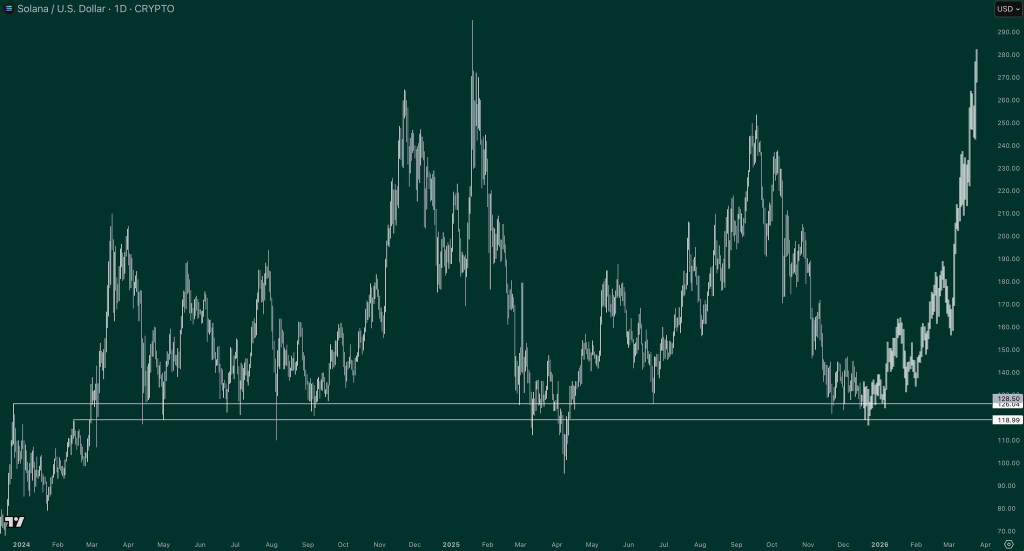
The Solana price chart spanning from 2024 to the present highlights a a demand zone between $119 and $126, which has proved resilient all this time.

Now, when writing, the SOL price today is once again hovering near $127, which is only marginally above this key support area.
Despite BOJ Concerns, Can SOL Price Hold Its Long-Term Support Zone?

While short-term volatility has shaken confidence at least for now, the broader structure suggests differently. Solana has sustained for many months above a long-term base. It has repeatedly acted as a stabilizing zone, and as long as the price sustains above it, a deeper breakdown is not yet confirmed.

Also, if this week’s turbulence is absorbed without major damage, short-term conditions could improve, while the long-term SOL price forecast remains structurally intact.

Macro Pressure Puts Solana at a Crossroads

That said, macro conditions are now driving the narrative more than charts alone. The upcoming Bank of Japan rate decision on December 19 has become a pivotal risk event for all risk assets, including Solana crypto.

Since, Japan has long been a source of ultra-cheap liquidity through the process of yen carry trade. Now, at this vulnerable financial state globally, a rate hike would likely force all those carry traders to immediately unwind their positions, and if they do unwind, it will trigger an immense selling pressure across global markets. If we take crypto market specifically, then its evident that in previous BoJ hikes during 2024 and 2025, Bitcoin USD experienced sharp drawdowns of 20–30%, and Solana followed closely.

If such a scenario unfolds again, the SOL price USD may struggle to defend current levels. Conversely, a pause or dovish stance is what market needs that could relieve pressure and allow price to stabilize.

Similarly, despite near-term uncertainty, Solana crypto’s fundamentals remain intact. Whatever the short-term result may be, the Network usage, developer activity, and ecosystem growth are undeniably strong, which continues to support its long-term narrative. If macro conditions stabilize even modestly, the current setup could favor recovery rather than continuation lower.

Regulation and 2026 Outlook Shape SOL Price Prediction

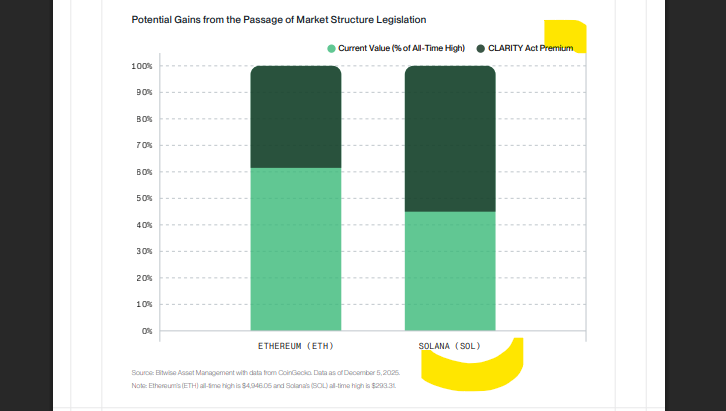
Looking further ahead, forward predictions for 2026 highlight that regulatory progress could be a decisive catalyst, per the latest Bitwise report. The CLARITY Act in U.S. is seen as essential for unlocking the next growth phase in crypto. 
Despite BOJ Concerns, Can SOL Price Hold Its Long-Term Support Zone?

Report also added that Stablecoins and tokenization are widely viewed as megatrends, and Solana is positioned as one of the major beneficiary if adoption accelerates.

If regulatory momentum continues and broader conditions remain constructive, the SOL price prediction 2026 becomes increasingly optimistic. 

Market Opportunity
Solana Logo
Solana Price(SOL)
$123.47
$123.47$123.47
-2.61%
USD
Solana (SOL) Live Price Chart
Disclaimer: The articles reposted on this site are sourced from public platforms and are provided for informational purposes only. They do not necessarily reflect the views of MEXC. All rights remain with the original authors. If you believe any content infringes on third-party rights, please contact service@support.mexc.com for removal. MEXC makes no guarantees regarding the accuracy, completeness, or timeliness of the content and is not responsible for any actions taken based on the information provided. The content does not constitute financial, legal, or other professional advice, nor should it be considered a recommendation or endorsement by MEXC.

You May Also Like

The Channel Factories We’ve Been Waiting For

The Channel Factories We’ve Been Waiting For

The post The Channel Factories We’ve Been Waiting For appeared on BitcoinEthereumNews.com. Visions of future technology are often prescient about the broad strokes while flubbing the details. The tablets in “2001: A Space Odyssey” do indeed look like iPads, but you never see the astronauts paying for subscriptions or wasting hours on Candy Crush.  Channel factories are one vision that arose early in the history of the Lightning Network to address some challenges that Lightning has faced from the beginning. Despite having grown to become Bitcoin’s most successful layer-2 scaling solution, with instant and low-fee payments, Lightning’s scale is limited by its reliance on payment channels. Although Lightning shifts most transactions off-chain, each payment channel still requires an on-chain transaction to open and (usually) another to close. As adoption grows, pressure on the blockchain grows with it. The need for a more scalable approach to managing channels is clear. Channel factories were supposed to meet this need, but where are they? In 2025, subnetworks are emerging that revive the impetus of channel factories with some new details that vastly increase their potential. They are natively interoperable with Lightning and achieve greater scale by allowing a group of participants to open a shared multisig UTXO and create multiple bilateral channels, which reduces the number of on-chain transactions and improves capital efficiency. Achieving greater scale by reducing complexity, Ark and Spark perform the same function as traditional channel factories with new designs and additional capabilities based on shared UTXOs.  Channel Factories 101 Channel factories have been around since the inception of Lightning. A factory is a multiparty contract where multiple users (not just two, as in a Dryja-Poon channel) cooperatively lock funds in a single multisig UTXO. They can open, close and update channels off-chain without updating the blockchain for each operation. Only when participants leave or the factory dissolves is an on-chain transaction…
Share
BitcoinEthereumNews2025/09/18 00:09
Singapore Entrepreneur Loses Entire Crypto Portfolio After Downloading Fake Game

Singapore Entrepreneur Loses Entire Crypto Portfolio After Downloading Fake Game

The post Singapore Entrepreneur Loses Entire Crypto Portfolio After Downloading Fake Game appeared on BitcoinEthereumNews.com. In brief A Singapore-based man has
Share
BitcoinEthereumNews2025/12/18 05:17
‘Rich Dad Poor Dad’ Author Kiyosaki Breaks Silence on Fed Rate Cut With Bitcoin Call

‘Rich Dad Poor Dad’ Author Kiyosaki Breaks Silence on Fed Rate Cut With Bitcoin Call

The post ‘Rich Dad Poor Dad’ Author Kiyosaki Breaks Silence on Fed Rate Cut With Bitcoin Call appeared on BitcoinEthereumNews.com. Robert Kiyosaki is back doing
Share
BitcoinEthereumNews2025/12/18 05:25