Macro investor Michael Green, who is known as the Cassandra of Passive Investing, has sharpened his critique of Bitcoin, arguing that its design makes it economically brittle and socially corrosive, setting up a winner-takes-all outcome “like a Monopoly game.” In an interview with journalist Phil Rosen, Green said “the most important thing to understand is […]Macro investor Michael Green, who is known as the Cassandra of Passive Investing, has sharpened his critique of Bitcoin, arguing that its design makes it economically brittle and socially corrosive, setting up a winner-takes-all outcome “like a Monopoly game.” In an interview with journalist Phil Rosen, Green said “the most important thing to understand is […]

Bitcoin Could End ‘Like A Monopoly Game,’ Claims Wall Street Cassandra Michael Green

Macro investor Michael Green, who is known as the Cassandra of Passive Investing, has sharpened his critique of Bitcoin, arguing that its design makes it economically brittle and socially corrosive, setting up a winner-takes-all outcome “like a Monopoly game.”

In an interview with journalist Phil Rosen, Green said “the most important thing to understand is that Bitcoin has marketed itself as multiple different things to try to appeal to investors at various points in time,” but has failed on its original brief. Under the Satoshi white paper, he noted, BTC was meant to be “a peer-to-peer payment system” that removed the dependence of payment rails on banks. “By moving to a distributed ledger and a peer-to-peer system, we’d be able to get banks out of the system.”

“That’s been a total failure,” he argued. “There are almost no real transactions that are occurring in Bitcoin. We have tons of transaction activity in speculative markets trading Bitcoin, but the actual quantity of retail transactions or peer-to-peer payments that occur over the Bitcoin network are remarkably small.”

Green distinguished between emergency government “money printing” and day-to-day bank credit. “There’s money printing that comes from the government, in which they largely are trying to smooth over mistakes that have been made,” he said, describing stimulus as a way to “basically create a do-over by printing money.”

More frequent, he added, is the expansion of money when banks lend: when a bank grants a $1,000 loan, “they simply created a new account for you called your checking account that has $1,000 in it… That expansion is totally normal and it has a credit function associated with it.”

“Bitcoin destroys the ability to do that because it was intentionally designed to skip the banking system,” Green contended. Rather than a full credit system, “it is effectively just a monetary system where what you’re really seeing is Bitcoin is effectively the tokens that are paid to the accounting firms that keep the blockchain in order… every Bitcoin that’s out there is basically a payment to Deloitte & Touche.”

Why Bitcoin Is Supposedly A ‘Monopoly Game’

Because its supply is capped and banks cannot create new BTC via lending, “no new money can be created. There is no capacity for mistake forgiveness in that type of framework,” he said. That makes the system “very limiting. Interest rates and credit spreads are just too high for a real economy framework.” Despite dramatic price gains, he concluded, Bitcoin “hasn’t emerged as a payment system” or “in any meaningful economic context.”

Green’s harshest criticism was distributional. “Because we have a finite quantity of it, ultimately, that means everybody who is born after the Bitcoin has been released finds themselves in deficit,” he said. He compared this to “a serf living off land in the 14th century that didn’t belong to you,” where “there was no other land that would ever become available to you.” That, he argued, “creates a deeply unequal society.”

Although he said he “was an early adopter of Bitcoin” and initially thought it was “a really interesting idea” of private money, he now believes “if you run through the simulation, Bitcoin, because there is a finite quantity of tokens, means that it basically plays like a Monopoly game.”

In that game, “you can’t add additional players as the game is being played… because they’re just going to lose very quickly. They don’t have any other properties. They don’t have any other money.” “How does every game of Monopoly end?” he asked. “Someone wins. With a single winner.”

“That’s exactly what we’ve seen within Bitcoin,” Green maintained, citing “increased concentration” and a Gini coefficient “beyond anything we’ve ever seen in the real world.” Instead of democratizing access, he argued, Bitcoin builds “a system that ultimately collapses upon itself and locks people out. Far from democratizing access, it does the exact opposite.”

At press time, BTC traded at $87,589.
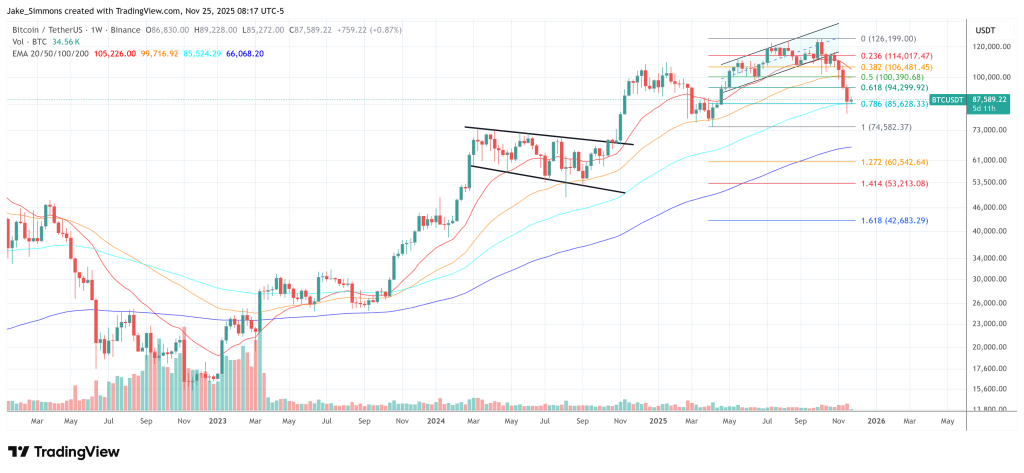
Bitcoin price
Market Opportunity
Wink Logo
Wink Price(LIKE)
$0.003345
$0.003345$0.003345
+0.66%
USD
Wink (LIKE) Live Price Chart
Disclaimer: The articles reposted on this site are sourced from public platforms and are provided for informational purposes only. They do not necessarily reflect the views of MEXC. All rights remain with the original authors. If you believe any content infringes on third-party rights, please contact service@support.mexc.com for removal. MEXC makes no guarantees regarding the accuracy, completeness, or timeliness of the content and is not responsible for any actions taken based on the information provided. The content does not constitute financial, legal, or other professional advice, nor should it be considered a recommendation or endorsement by MEXC.

You May Also Like

Robert W. Baird & Co. Discloses Core AI Design Parameters and Launches Public Testing of Baird NEUROFORGE™ Equity AI

Robert W. Baird & Co. Discloses Core AI Design Parameters and Launches Public Testing of Baird NEUROFORGE™ Equity AI

New York, United States (PinionNewswire) — Robert W. Baird & Co. (“Baird”) today announced the public disclosure of selected core system design parameters of its
Share
AI Journal2025/12/23 02:16
Best Crypto to Buy as Saylor & Crypto Execs Meet in US Treasury Council

Best Crypto to Buy as Saylor & Crypto Execs Meet in US Treasury Council

The post Best Crypto to Buy as Saylor & Crypto Execs Meet in US Treasury Council appeared on BitcoinEthereumNews.com. Michael Saylor and a group of crypto executives met in Washington, D.C. yesterday to push for the Strategic Bitcoin Reserve Bill (the BITCOIN Act), which would see the U.S. acquire up to 1M $BTC over five years. With Bitcoin being positioned yet again as a cornerstone of national monetary policy, many investors are turning their eyes to projects that lean into this narrative – altcoins, meme coins, and presales that could ride on the same wave. Read on for three of the best crypto projects that seem especially well‐suited to benefit from this macro shift:  Bitcoin Hyper, Best Wallet Token, and Remittix. These projects stand out for having a strong use case and high adoption potential, especially given the push for a U.S. Bitcoin reserve.   Why the Bitcoin Reserve Bill Matters for Crypto Markets The strategic Bitcoin Reserve Bill could mark a turning point for the U.S. approach to digital assets. The proposal would see America build a long-term Bitcoin reserve by acquiring up to one million $BTC over five years. To make this happen, lawmakers are exploring creative funding methods such as revaluing old gold certificates. The plan also leans on confiscated Bitcoin already held by the government, worth an estimated $15–20B. This isn’t just a headline for policy wonks. It signals that Bitcoin is moving from the margins into the core of financial strategy. Industry figures like Michael Saylor, Senator Cynthia Lummis, and Marathon Digital’s Fred Thiel are all backing the bill. They see Bitcoin not just as an investment, but as a hedge against systemic risks. For the wider crypto market, this opens the door for projects tied to Bitcoin and the infrastructure that supports it. 1. Bitcoin Hyper ($HYPER) – Turning Bitcoin Into More Than Just Digital Gold The U.S. may soon treat Bitcoin as…
Share
BitcoinEthereumNews2025/09/18 00:27
BlackRock boosts AI and US equity exposure in $185 billion models

BlackRock boosts AI and US equity exposure in $185 billion models

The post BlackRock boosts AI and US equity exposure in $185 billion models appeared on BitcoinEthereumNews.com. BlackRock is steering $185 billion worth of model portfolios deeper into US stocks and artificial intelligence. The decision came this week as the asset manager adjusted its entire model suite, increasing its equity allocation and dumping exposure to international developed markets. The firm now sits 2% overweight on stocks, after money moved between several of its biggest exchange-traded funds. This wasn’t a slow shuffle. Billions flowed across multiple ETFs on Tuesday as BlackRock executed the realignment. The iShares S&P 100 ETF (OEF) alone brought in $3.4 billion, the largest single-day haul in its history. The iShares Core S&P 500 ETF (IVV) collected $2.3 billion, while the iShares US Equity Factor Rotation Active ETF (DYNF) added nearly $2 billion. The rebalancing triggered swift inflows and outflows that realigned investor exposure on the back of performance data and macroeconomic outlooks. BlackRock raises equities on strong US earnings The model updates come as BlackRock backs the rally in American stocks, fueled by strong earnings and optimism around rate cuts. In an investment letter obtained by Bloomberg, the firm said US companies have delivered 11% earnings growth since the third quarter of 2024. Meanwhile, earnings across other developed markets barely touched 2%. That gap helped push the decision to drop international holdings in favor of American ones. Michael Gates, lead portfolio manager for BlackRock’s Target Allocation ETF model portfolio suite, said the US market is the only one showing consistency in sales growth, profit delivery, and revisions in analyst forecasts. “The US equity market continues to stand alone in terms of earnings delivery, sales growth and sustainable trends in analyst estimates and revisions,” Michael wrote. He added that non-US developed markets lagged far behind, especially when it came to sales. This week’s changes reflect that position. The move was made ahead of the Federal…
Share
BitcoinEthereumNews2025/09/18 01:44
