TLDR SOS surges after hours despite widening losses and sharp cash depletion. SOS pivots to commodities; revenue up, but losses and cash risks grow. SOS earnings lift stock post-market as revenue jumps 48% on rubber sales. SOS revenue surges, but losses deepen and liquidity remains a concern. SOS stock rallies after hours on growth, despite [...] The post SOS Limited (SOS) Stock: Revenue Surges 48%, But Net Loss and Cash Burn Raise Red Flags appeared first on CoinCentral.TLDR SOS surges after hours despite widening losses and sharp cash depletion. SOS pivots to commodities; revenue up, but losses and cash risks grow. SOS earnings lift stock post-market as revenue jumps 48% on rubber sales. SOS revenue surges, but losses deepen and liquidity remains a concern. SOS stock rallies after hours on growth, despite [...] The post SOS Limited (SOS) Stock: Revenue Surges 48%, But Net Loss and Cash Burn Raise Red Flags appeared first on CoinCentral.

SOS Limited (SOS) Stock: Revenue Surges 48%, But Net Loss and Cash Burn Raise Red Flags

TLDR

  • SOS surges after hours despite widening losses and sharp cash depletion.
  • SOS pivots to commodities; revenue up, but losses and cash risks grow.
  • SOS earnings lift stock post-market as revenue jumps 48% on rubber sales.
  • SOS revenue surges, but losses deepen and liquidity remains a concern.
  • SOS stock rallies after hours on growth, despite cash crunch and losses.

SOS stock closed at $1.95 during regular trading on September 26, 2025, down 3.94% from the prior session. However, shares surged 17.95% after hours to $2.30 following the earnings release. The contrasting stock reaction reflects optimism around revenue growth but concern over losses and cash depletion.
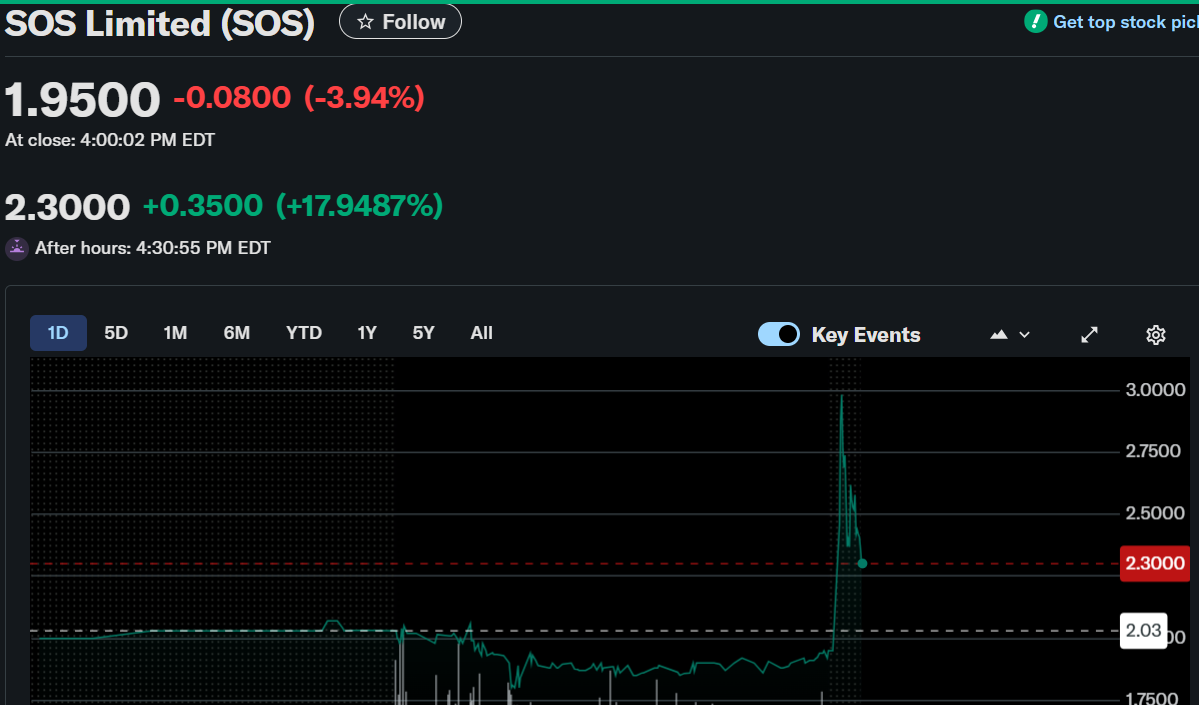
SOS Limited (SOS

Revenue Growth Driven by Commodities Trading

SOS Limited reported semi-annual results for the six months ended June 30, 2025. The company achieved revenue of $89.6 million, reflecting a 48.1% increase from the prior year. Growth came mainly from higher natural rubber sales as demand in China recovered steadily.

The commodities trading segment contributed 94.9% of revenue, while hosting services delivered 4.3% and others provided 0.8%. The company shifted away from cryptocurrency mining operations to focus on hosting services. Management highlighted stronger demand for third-party hosting despite suspending self-mining.

Nevertheless, despite higher revenue, SOS faced a gross loss of $1.3 million, reversing a gross profit of $2.4 million in 2024. The gross margin stood at negative 1.5%, down from a positive 4% in the previous year. Falling rubber spot prices and losses from petroleum coke weighed heavily on profitability.

Losses Widen and Costs Escalate

The company recorded a GAAP net loss of $14.2 million, a 30.3% increase from last year’s $10.9 million. Operating costs surged 56.5% to $90.9 million, outpacing revenue growth and further pressuring margins. Selling expenses rose slightly to $2.3 million, mainly due to higher transportation costs.

General and administrative expenses dropped 35% to $9.4 million as mining machines were fully impaired and required no depreciation. However, this reduction did not offset the broader rise in costs across operations. The loss per share was $(0.0139), compared with $(0.0299) a year earlier.

The company sold petroleum coke inventory at cost and absorbed over $1.6 million in losses from rubber price declines. Management emphasized a strategy of pursuing market share over short-term profitability. Competitive pricing was prioritized to maintain trading volume amid challenging conditions.

Liquidity Risks and Strategic Investments

Cash and cash equivalents fell sharply to $4.2 million from $246.7 million a year earlier. The decline of 98.3% resulted mainly from a $228.4 million prepayment for blockchain commodity trading platform development. Management described the payment as a move to secure long-term value and secure critical partner resources.

During the reporting period, the company raised $6.8 million in net proceeds through a registered direct offering under Form F-3. Despite this, liquidity remains constrained, and further capital raising plans have been confirmed. The shift underscores the company’s ongoing dependence on external funding to sustain operations.


The post SOS Limited (SOS) Stock: Revenue Surges 48%, But Net Loss and Cash Burn Raise Red Flags appeared first on CoinCentral.

Market Opportunity
SOS Logo
SOS Price(SOS)
$0.000000001563
$0.000000001563$0.000000001563
+4.68%
USD
SOS (SOS) Live Price Chart
Disclaimer: The articles reposted on this site are sourced from public platforms and are provided for informational purposes only. They do not necessarily reflect the views of MEXC. All rights remain with the original authors. If you believe any content infringes on third-party rights, please contact service@support.mexc.com for removal. MEXC makes no guarantees regarding the accuracy, completeness, or timeliness of the content and is not responsible for any actions taken based on the information provided. The content does not constitute financial, legal, or other professional advice, nor should it be considered a recommendation or endorsement by MEXC.

You May Also Like

The Channel Factories We’ve Been Waiting For

The Channel Factories We’ve Been Waiting For

The post The Channel Factories We’ve Been Waiting For appeared on BitcoinEthereumNews.com. Visions of future technology are often prescient about the broad strokes while flubbing the details. The tablets in “2001: A Space Odyssey” do indeed look like iPads, but you never see the astronauts paying for subscriptions or wasting hours on Candy Crush.  Channel factories are one vision that arose early in the history of the Lightning Network to address some challenges that Lightning has faced from the beginning. Despite having grown to become Bitcoin’s most successful layer-2 scaling solution, with instant and low-fee payments, Lightning’s scale is limited by its reliance on payment channels. Although Lightning shifts most transactions off-chain, each payment channel still requires an on-chain transaction to open and (usually) another to close. As adoption grows, pressure on the blockchain grows with it. The need for a more scalable approach to managing channels is clear. Channel factories were supposed to meet this need, but where are they? In 2025, subnetworks are emerging that revive the impetus of channel factories with some new details that vastly increase their potential. They are natively interoperable with Lightning and achieve greater scale by allowing a group of participants to open a shared multisig UTXO and create multiple bilateral channels, which reduces the number of on-chain transactions and improves capital efficiency. Achieving greater scale by reducing complexity, Ark and Spark perform the same function as traditional channel factories with new designs and additional capabilities based on shared UTXOs.  Channel Factories 101 Channel factories have been around since the inception of Lightning. A factory is a multiparty contract where multiple users (not just two, as in a Dryja-Poon channel) cooperatively lock funds in a single multisig UTXO. They can open, close and update channels off-chain without updating the blockchain for each operation. Only when participants leave or the factory dissolves is an on-chain transaction…
Share
BitcoinEthereumNews2025/09/18 00:09
U Mobile and IGB Collaborate on Malaysia’s 5G Indoor Networks

U Mobile and IGB Collaborate on Malaysia’s 5G Indoor Networks

U Mobile partners with IGB Berhad for 5G indoor network deployment across 20 Malaysian properties.
Share
bitcoininfonews2025/12/21 20:20
SOL Price Prediction: Targeting $165-175 Recovery Within 6 Weeks as Technical Setup Improves

SOL Price Prediction: Targeting $165-175 Recovery Within 6 Weeks as Technical Setup Improves

The post SOL Price Prediction: Targeting $165-175 Recovery Within 6 Weeks as Technical Setup Improves appeared on BitcoinEthereumNews.com. Felix Pinkston Dec
Share
BitcoinEthereumNews2025/12/21 19:51