TLDR Apple stock plunged at $254.43on Sept. 24 down by 1.26% YTD but behind Big Tech peers. UBS data shows strong wait times for iPhone 17 Base but muted demand for higher-end models. ASP growth may be limited by pricing strategy favoring entry-level buyers. The iPhone 17 Air’s $999 redesign and China subsidies boost near-term [...] The post Apple Inc. ($AAPL) Stock: Turns Positive in 2025 After iPhone 17 Launch appeared first on CoinCentral.TLDR Apple stock plunged at $254.43on Sept. 24 down by 1.26% YTD but behind Big Tech peers. UBS data shows strong wait times for iPhone 17 Base but muted demand for higher-end models. ASP growth may be limited by pricing strategy favoring entry-level buyers. The iPhone 17 Air’s $999 redesign and China subsidies boost near-term [...] The post Apple Inc. ($AAPL) Stock: Turns Positive in 2025 After iPhone 17 Launch appeared first on CoinCentral.

Apple Inc. ($AAPL) Stock: Turns Positive in 2025 After iPhone 17 Launch

TLDR

  • Apple stock plunged at $254.43on Sept. 24 down by 1.26% YTD but behind Big Tech peers.

  • UBS data shows strong wait times for iPhone 17 Base but muted demand for higher-end models.

  • ASP growth may be limited by pricing strategy favoring entry-level buyers.

  • The iPhone 17 Air’s $999 redesign and China subsidies boost near-term demand.

  • Apple still lags Microsoft and Google in AI, with major Siri updates delayed until 2026.

Apple Inc. (AAPL) shares were down 1.21% as of 12:46 PM EDT, dropping from around $254.43 to $251.36.
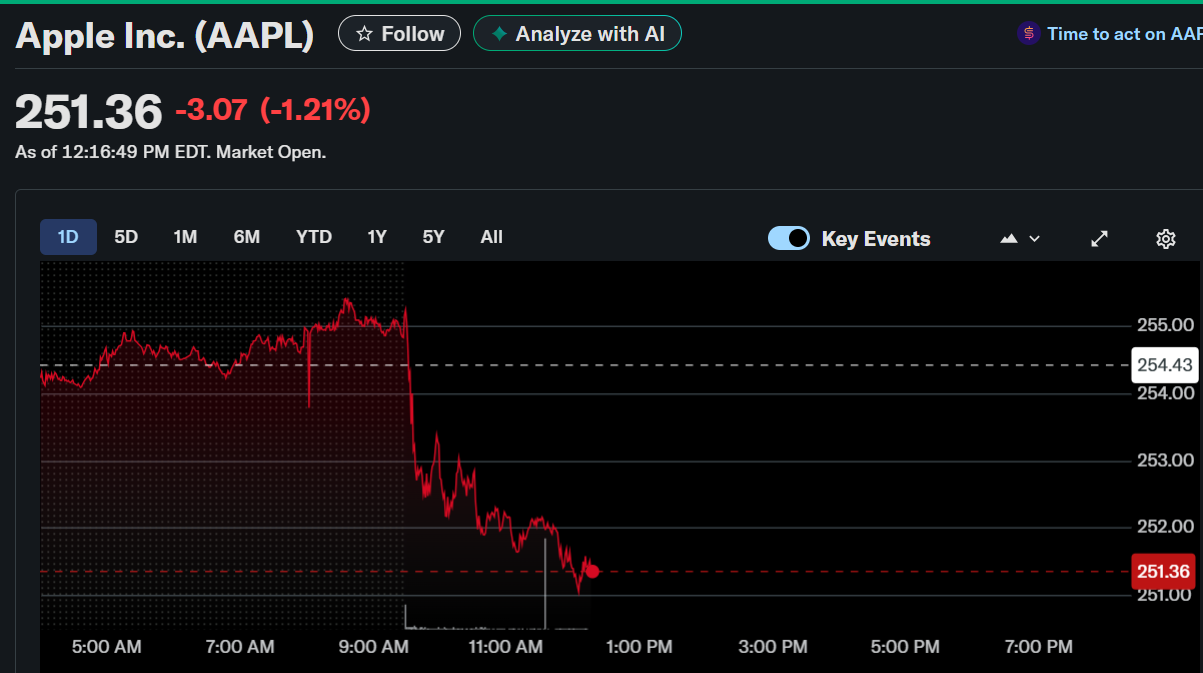
Apple Inc. (AAPL)

With these gains, Apple has erased its 2025 losses, now up 1.96% year-to-date, though still trailing the S&P 500’s 13.18% rise. The September 25 earnings report will give further clarity on Apple’s momentum.

The rally followed strong initial demand for Apple’s newly launched iPhone 17 lineup. Shares climbed 4% earlier this week as shipping times lengthened for the redesigned iPhone Air, signaling healthy interest heading into the holiday quarter.

UBS warns of ASP pressure

Despite the positive stock reaction, UBS analysts flagged potential risks for Apple’s average selling price. Evidence Lab data showed “elevated year-over-year wait times” for the iPhone 17 Base model across 30 tracked markets, while demand for higher-end models like the Pro Max looked flatter.

In the U.S., wait times for the iPhone 17 Base stretched to 18 days versus 11 days for the iPhone 16 Base. In China, wait times jumped to 25 days compared with 9 days for last year’s model, which UBS partly attributed to subsidies. However, the analysts noted that heavy mixing toward entry-level models may dampen ASP upside this quarter.

Apple’s pricing strategy

UBS pointed to Apple’s strategic pricing adjustments. The Base model now starts with 256GB storage, effectively lowering its price per gigabyte, while the Air and Pro models saw implied price increases. This mix could weigh on revenue per unit even if total shipments grow.

The $999 iPhone Air is proving a strong draw, being Apple’s first major redesign in years. Bank of America analysts reported longer delivery windows of 18 days for the Air compared with just 10 days for last year’s iPhone 16.

Broader product ecosystem and AI lag

Apple’s fall lineup also included new AirPods Pro 3 and the latest Apple Watch, which introduced AI-driven health features such as blood pressure risk alerts. Still, the company lags competitors in AI innovation. A major Siri update isn’t expected until 2026, leaving Apple behind Microsoft and Google, both of which have heavily invested in AI this year.

Performance overview

Looking beyond 2025, Apple remains a long-term outperformer. The company has returned 12.87% over the past year and 144.18% over five years, compared with the S&P 500’s 16.41% and 105.66% gains, respectively. Yet the near-term focus rests squarely on the iPhone 17’s holiday season performance and whether Apple can sustain momentum despite ASP concerns and AI challenges.

The post Apple Inc. ($AAPL) Stock: Turns Positive in 2025 After iPhone 17 Launch appeared first on CoinCentral.

Market Opportunity
NEAR Logo
NEAR Price(NEAR)
$1.465
$1.465$1.465
-3.42%
USD
NEAR (NEAR) Live Price Chart
Disclaimer: The articles reposted on this site are sourced from public platforms and are provided for informational purposes only. They do not necessarily reflect the views of MEXC. All rights remain with the original authors. If you believe any content infringes on third-party rights, please contact service@support.mexc.com for removal. MEXC makes no guarantees regarding the accuracy, completeness, or timeliness of the content and is not responsible for any actions taken based on the information provided. The content does not constitute financial, legal, or other professional advice, nor should it be considered a recommendation or endorsement by MEXC.

You May Also Like

The Channel Factories We’ve Been Waiting For

The Channel Factories We’ve Been Waiting For

The post The Channel Factories We’ve Been Waiting For appeared on BitcoinEthereumNews.com. Visions of future technology are often prescient about the broad strokes while flubbing the details. The tablets in “2001: A Space Odyssey” do indeed look like iPads, but you never see the astronauts paying for subscriptions or wasting hours on Candy Crush.  Channel factories are one vision that arose early in the history of the Lightning Network to address some challenges that Lightning has faced from the beginning. Despite having grown to become Bitcoin’s most successful layer-2 scaling solution, with instant and low-fee payments, Lightning’s scale is limited by its reliance on payment channels. Although Lightning shifts most transactions off-chain, each payment channel still requires an on-chain transaction to open and (usually) another to close. As adoption grows, pressure on the blockchain grows with it. The need for a more scalable approach to managing channels is clear. Channel factories were supposed to meet this need, but where are they? In 2025, subnetworks are emerging that revive the impetus of channel factories with some new details that vastly increase their potential. They are natively interoperable with Lightning and achieve greater scale by allowing a group of participants to open a shared multisig UTXO and create multiple bilateral channels, which reduces the number of on-chain transactions and improves capital efficiency. Achieving greater scale by reducing complexity, Ark and Spark perform the same function as traditional channel factories with new designs and additional capabilities based on shared UTXOs.  Channel Factories 101 Channel factories have been around since the inception of Lightning. A factory is a multiparty contract where multiple users (not just two, as in a Dryja-Poon channel) cooperatively lock funds in a single multisig UTXO. They can open, close and update channels off-chain without updating the blockchain for each operation. Only when participants leave or the factory dissolves is an on-chain transaction…
Share
BitcoinEthereumNews2025/09/18 00:09
Let insiders trade – Blockworks

Let insiders trade – Blockworks

The post Let insiders trade – Blockworks appeared on BitcoinEthereumNews.com. This is a segment from The Breakdown newsletter. To read more editions, subscribe ​​“The most valuable commodity I know of is information.” — Gordon Gekko, Wall Street Ten months ago, FBI agents raided Shayne Coplan’s Manhattan apartment, ostensibly in search of evidence that the prediction market he founded, Polymarket, had illegally allowed US residents to place bets on the US election. Two weeks ago, the CFTC gave Polymarket the green light to allow those very same US residents to place bets on whatever they like. This is quite the turn of events — and it’s not just about elections or politics. With its US government seal of approval in hand, Polymarket is reportedly raising capital at a valuation of $9 billion — a reflection of the growing belief that prediction markets will be used for much more than betting on elections once every four years. Instead, proponents say prediction markets can provide a real service to the world by providing it with better information about nearly everything. I think they might, too — but only if insiders are free to participate. Yesterday, for example, Polymarket announced new betting markets on company earnings reports, with a promise that it would improve the information that investors have to work with.  Instead of waiting three months to find out how a company is faring, investors could simply watch the odds on Polymarket.  If the probability of an earnings beat is rising, for example, investors would know at a glance that things are going well. But that will only happen if enough of the people betting actually know how things are going. Relying on the wisdom of crowds to magically discern how a business is doing won’t add much incremental knowledge to the world; everyone’s guesses are unlikely to average out to the truth. If…
Share
BitcoinEthereumNews2025/09/18 05:16
U Mobile and IGB Collaborate on Malaysia’s 5G Indoor Networks

U Mobile and IGB Collaborate on Malaysia’s 5G Indoor Networks

U Mobile partners with IGB Berhad for 5G indoor network deployment across 20 Malaysian properties.
Share
bitcoininfonews2025/12/21 20:20